Henriette Seydel
→ go down to colonial traces of German East Africa in Germany
The colonial legacy continues to have an impact not only in Tanzania but also in Germany. Over the course of history cultures of memory changed alongside domestic political events.
1918-1933: Exoticization and revisionism
With the Treaty of Versailles in 1919, Germany lost its colonies to the Allies. In Germany, this was referred to as the ‘colonial guilt lie’ – an expression of revisionist colonial movements. At the same time, exoticism and commerce boomed in human zoos and colonial goods stores with racist advertising for coffee, chocolate and rum. Travelogues, novels and films romanticized the colonial heritage as adventurous and heroic. Monuments were erected and streets named after German ‘colonial heroes’ such as Hermann von Wissmann and Paul von Lettow-Vorbeck.
1933-1945: Colonial heroism and racism
In 1939, the German East Africa War Memorial was erected in Hamburg, depicting Paul von Lettow-Vorbeck and Askari. Forgotten or concealed during the Weimar Republic, Carl Peters became socially acceptable again in Nazi Germany. The brutal colonial ruler was celebrated as the ideal image of German masculinity, bravery and white supremacy. Imperialists demanded the reacquisition of the colonies and dreamed of a German ‘Central Africa’ that would serve as a new settlement area, source of raw materials, sales market and labour recruitment area. For the National Socialists, on the other hand, the initial goal was to expand their ‘living space’ in Eastern Europe. The colonial past was also visible in the presence of Black and Asian people in the German Reich, for example, colonial migrants who had previously served as Askari, mission school students, artists from human zoos or musicians, as well as Black Germans. Underpinned by a racial ideology that had already been researched pseudo-scientifically during the colonial era, non-Whites and non-Aryans were discriminated against, ostracized, deprived of their rights and murdered in concentration camps.1
1945–1967: Establishment of East and West German cooperation with Tanganyika and Zanzibar
After the Second World War, critical engagement with the colonial past played hardly any role and racist stereotypes persisted. In the GDR, responsibility for the history of violent oppression was attributed to West Germany. Colonial monuments were removed and African independence movements were supported as part of the global proletariat. There was cultural, economic and academic cooperation between the GDR and Tanganyika. However, the GDR also had an influence on the Zanzibar secret service, which, like the Stasi, used methods of intimidation and surveillance. In the Federal Republic of Germany, the media, films, books and advertising painted a picture of Africa as a place of hunger, poverty and need. Under the heading of development aid, economic and infrastructure projects were financed and supported with skilled workers. Until 1964, the Federal Republic of Germany was Tanganyika’s third largest donor.
1968–1990: Solidarity and Nostalgia
The 1968 movement and the Third World solidarity movement criticized the euphemistic treatment of Germany’s own past. Exchanges with students from the Global South were the catalyst for confronting the colonial legacy. In some West German cities, colonial monuments were subsequently supplemented with critical text panels or rededicated as memorials. However, anti-colonial attitudes remained predominantly in civil society circles, especially in diaspora and Afro-German communities. The majority of the population either forgot and ignored the colonial past or remembered it nostalgically. ‘Third World tourism’ to countries in the Global South began to establish itself. The FRG’s resumption of development cooperation in Tanzania was questioned in some quarters. Project ruins, debt, language problems and blocked career opportunities for local professionals reinforced dependencies, according to critics.
1990-2004: Colonial Amnesia and Criticism
After reunification, Germany’s Africa policy remained marginal. The Federal Republic saw itself as comparatively unburdened by its colonial past, a phenomenon known as ‘colonial amnesia’. In the 2000s, films and novels about Africa also experienced a comeback, not as a confrontation with colonial history, but as a romanticized portrayal of Africa as a place of longing, full of authenticity and adventure. A turning point came in 2004 when Development Minister Wieczorek-Zeul apologized for German colonial crimes in Namibia – a gesture from which the federal government later distanced itself in order to avoid demands for reparations. This speech reflected the growing postcolonial critical debates in academia and civil society.
2005–2025: Decolonization and Neocolonialism
In 2005, no government representatives appeared in Berlin for the erection of a memorial stele to the so-called Congo Conference or for commemorative events marking the 100th anniversary of the Maji Maji War. Once again, it was German and Tanzanian civil society, church and academic actors who addressed the issue of colonialism. To this day, numerous NGOs, local postcolonial initiatives, Afro-German and African Black people and BiPoC, as well as academics are involved in decolonial anti-racism and education work. They organize city tours, readings, film evenings and panel discussions, produce films, podcasts, newspaper articles and books, hold demonstrations and art projects, and demand street renaming and restitution. The topic is also finding its place in the arts and culture sector: in museums, exhibitions, dance and theatre projects. The increasing number of joint research projects, such as the Humboldt Lab or a German-Rwandan collaboration to research human remains from Rwanda and Tanzania, point to an academic rethinking of transnational cooperation.
Colonial revisionists, on the other hand, set a different focus by commemorating fallen German soldiers, relativizing colonial crimes, highlighting colonial achievements, or collecting militaria and stamps from the colonial era. Colonial goods shops and colonial-style furniture, which nostalgically evoke the ‘good old days,’ remain en vogue. The media, advertising for tourist trips to African countries, and development projects continue to perpetuate racist and colonial stereotypes, Eurocentrism, and exoticism.
After the 2018 federal election, the topic of colonialism was mentioned for the first time in the coalition agreement, explaining that, in addition to the historical legacy of the GDR and the Nazi past, the colonial legacy should also find a place in the collective memory. In 2023, during his trip to Tanzania, Federal President Frank-Walter Steinmeier asked for forgiveness for the colonial atrocities. A museum of colonial history, nationwide days of remembrance or a central memorial for the victims of German colonial rule have not yet been realized.
As long as Tanzanians are searching for human remains, an unknown number of cultural artefacts remain in German museums, archives and cellars, streets across the country continue to be named after colonial criminals, statues celebrating them as heroes still stand, and there is widespread ignorance among the population about German colonial crimes, the decolonial reappraisal of the German-Tanzanian colonial past in Germany remains an important task.
COLONIAL TRACES OF GERMAN EAST AFRICA IN GERMANY
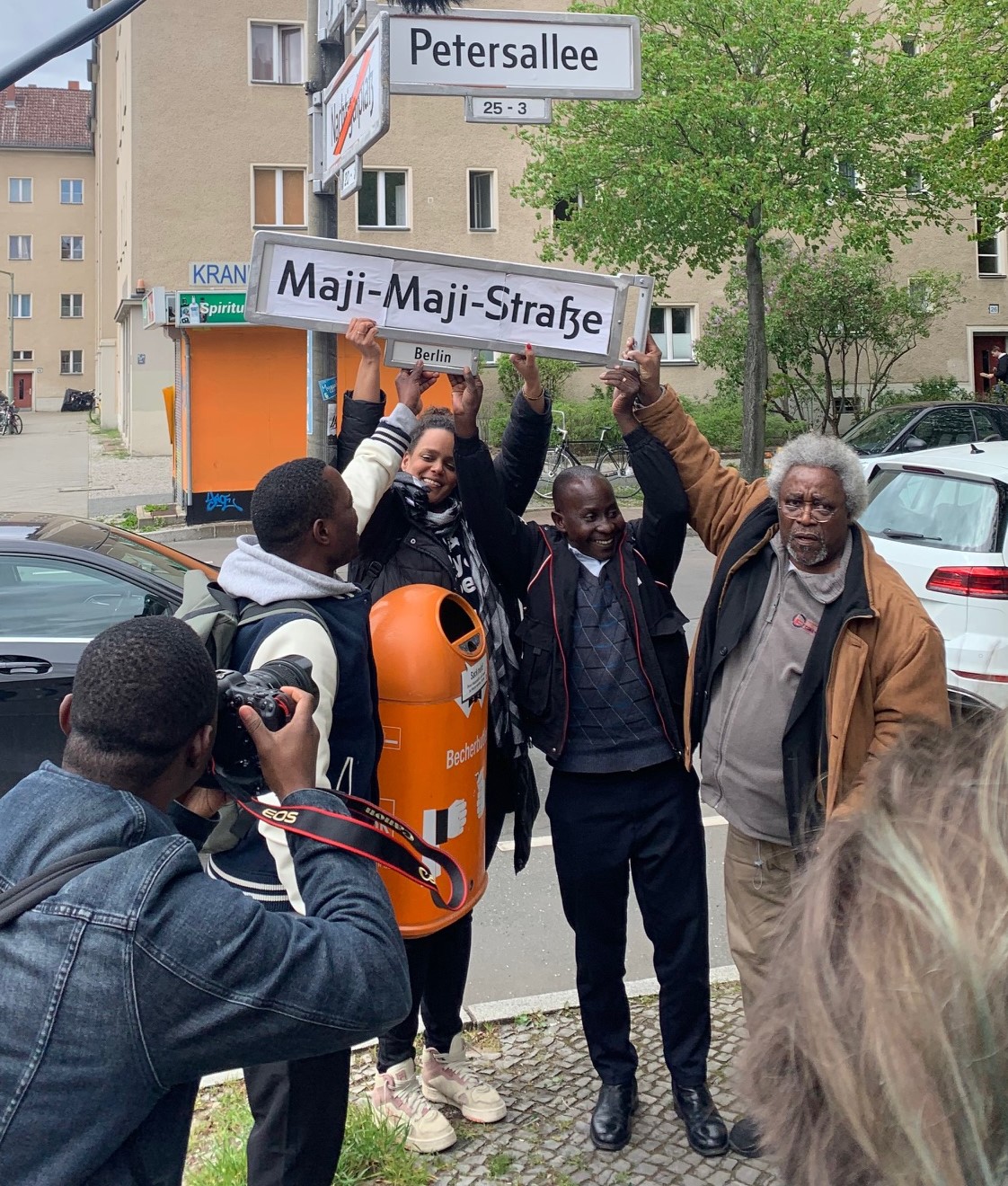
Berlin symbolische Umbenennung der Petersallee in Maji-Maji-Straße (c) Daniela Tschuschke 
„Deutsch-Ostafrika-Kriegermal“ im Hamburger „Tansaniapark“ (c) Dirtsc / Wikimedia 
Hannover: Carl Peters Monument (c) Christian Schd / Wikimedia 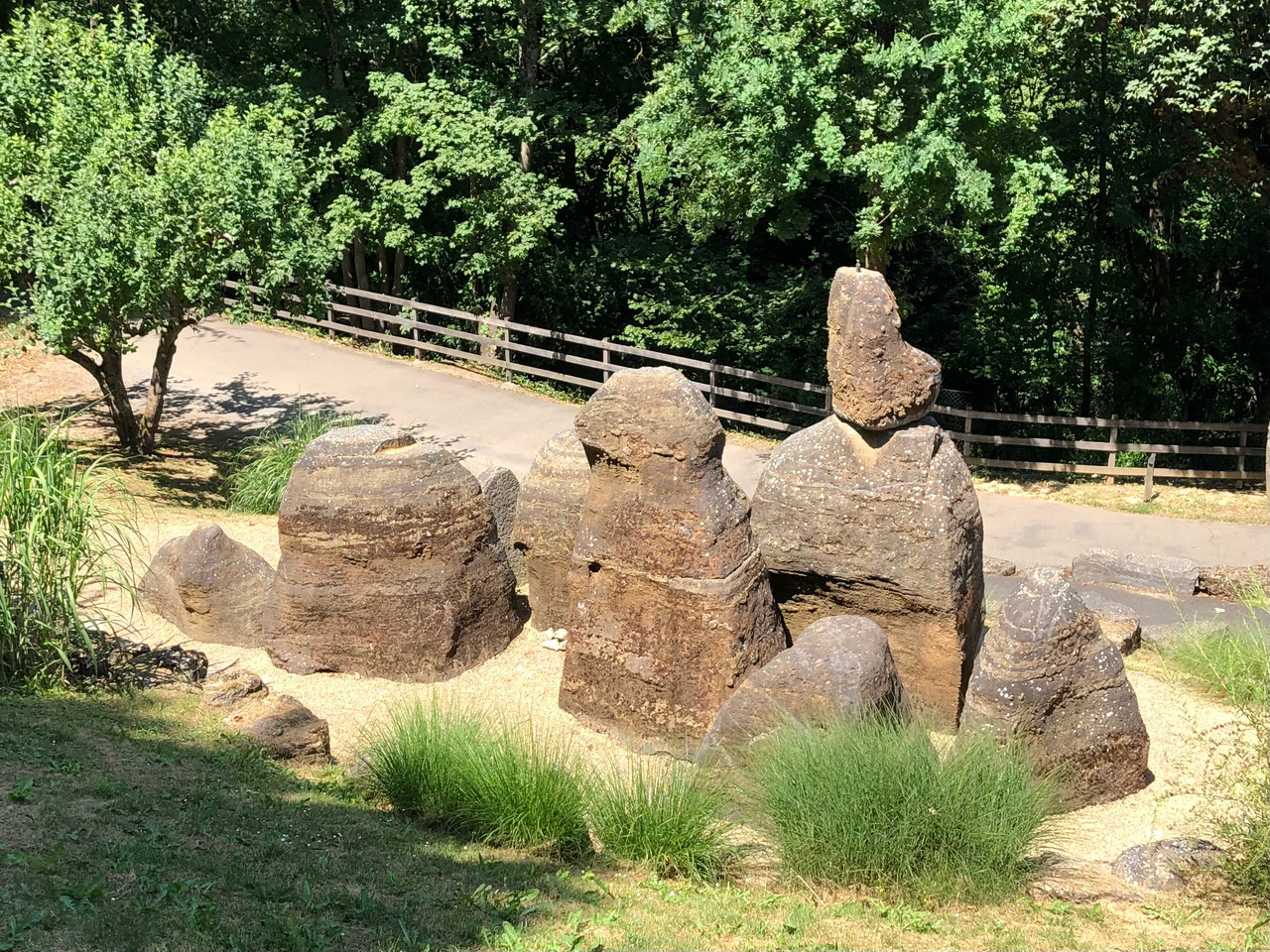
Bismarck Rock im Mwanza-Garten in Würzburg, der Partnerstadt Mwanzas (c) Ramona Seitz 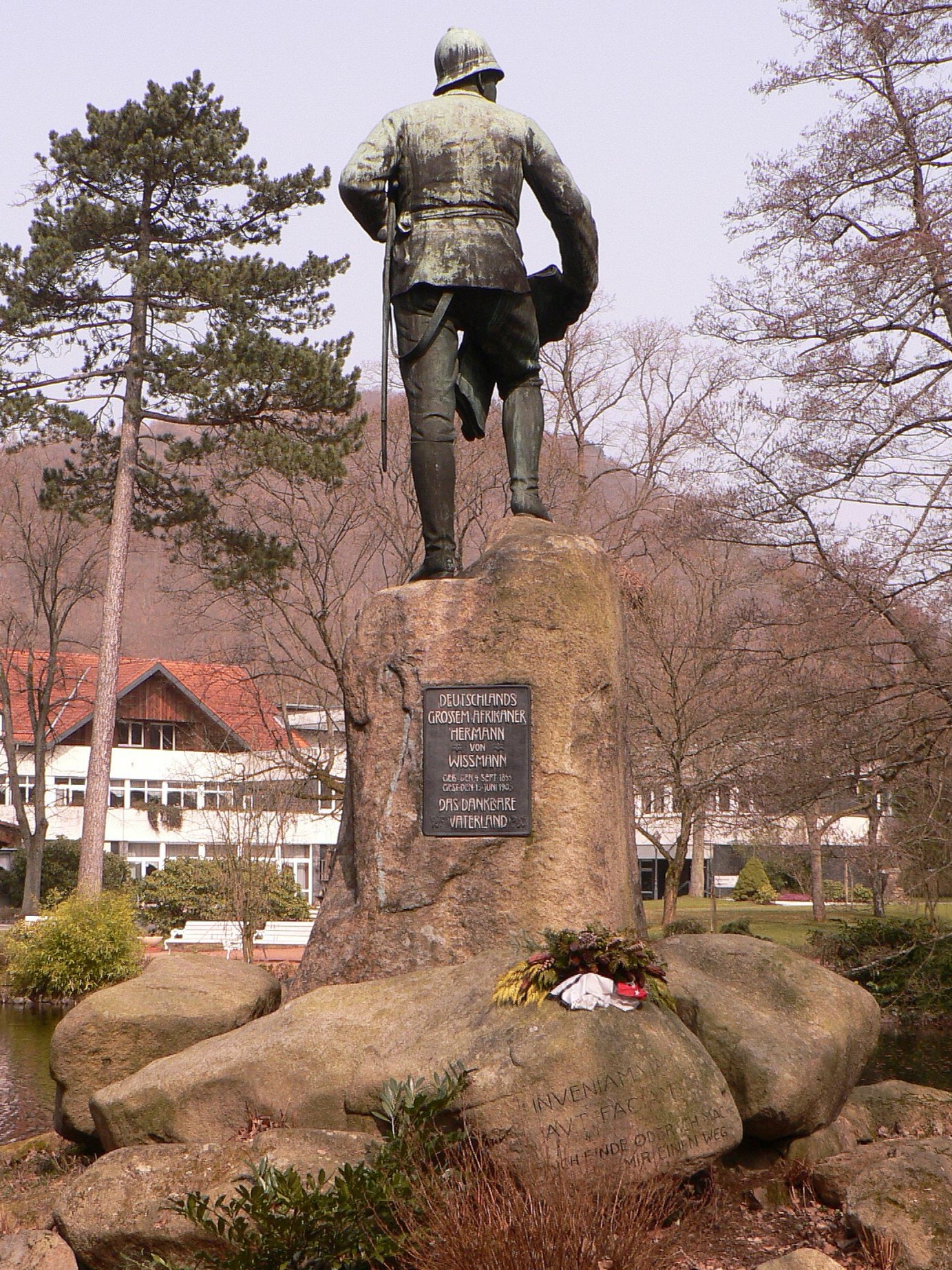
Wissmannstatue in Bad Lauterberg (c) Kassandro – Wikimedia 
Tangastraße in München
Hanover: Carl Peters Monument
The Carl Peters Monument in Hanover, erected in 1930, was supplemented in 1988, after many years of debate, with a plaque commemorating anti-colonialism, which covers the original inscription ‘To the great Lower Saxon Carl Peters, who acquired German East Africa for us’. Activists are campaigning for the monument to be removed.
Bad Lauterberg: Wissmann Monument
There is a monument to Hermann von Wissmann in his hometown. Göttingen Postkolonial advocates a critical approach to the monument, as the statue with the inaccurate dedication ‘to the great African’ still stands in the spa gardens of Bad Lauterberg today.
Hamburg: Tanzania Park and German East Africa War Memorial
The ‘German East Africa War Memorial’ stands in the so-called Tanzania Park on the site of the former Lettow-Vorbeck barracks. Until 1990, recruits from the German Armed Forces were trained here and, together with the traditional association of former protection and overseas troops, wreaths were laid annually. The park and memorial remain the subject of controversial debate.
Munich: Tanga Street
In the Bavarian capital, as well as in Cologne and Berlin, streets are named after the ‘Battle of Tanga.’ In 1914, the Germans defeated the British-Indian troops. General Paul von Lettow-Vorbeck was celebrated as a hero. The fact that hundreds of thousands of Africans – Askari soldiers and the local population – died in these battles on the East African coast was ignored. (-> MUC Postkolonial)
Berlin: Peters-Allee
After decades of civil society engagement, primarily from the African/Black community, Petersallee, named by the National Socialists in 1939, was renamed Maji-Maji-Allee and Anna-Mungunda-Allee. This means that one of the most cruel colonial criminals is no longer honoured, but instead the Maji Maji resistance movement and an anti-apartheid activist from the Ovaherero tribe are commemorated. (-> Berlin Postkolonial)
Würzburg: Bismarck Rocks
To mark the 50th anniversary of the Mwanza-Würzburg town twinning, a replica of the landmark of the city of Mwanza, the Bismarck Rock in Lake Victoria, was erected in 2016. Critical voices are calling for the Bismarck Rocks to be renamed – both in Mwanza and in Würzburg – so that Reich Chancellor Otto von Bismarck, the key figure in the colonization of Africa, is no longer honoured.
Further Information
- Burton, Eric (2021): In Diensten des Afrikanischen Sozialismus. Tansania und die globale Entwicklungsarbeit der beiden deutschen Staaten, 1961–1990. Berlin/Boston: Walter de Gruyter.
- Haug, Frederik (2018): Verbrannte Erde. Die Haltung der Bundesregierung hinsichtlich des kolonialen Gewalthandelns des Deutschen Kaiserreichs in Deutsch-Ostafrika. Potsdam: Universitätsverlag.
- Heyden, Ulrich van der & Benger, Franziska (2009): Kalter Krieg in Ostafrika. Die Beziehungen der DDR zu Sansibar und Tansania. Münster: LIT Verlag
- Heyden, Ulrich van der & Zeller, Joachim (2007): Kolonialismus hierzulande – Eine Spurensuche in Deutschland. Erfurt: Sutton Verlag.
- Mietzner, Angelika & Storch, Anne (2025): Koloniale Kontinuitäten: Afrikabilder und Tourismus in der deutschen Provinz. Bielefeld: Transcript.
- Schilling, Britta (2014): Postcolonial Germany. Memories of Empire in a Decolonized Nation. Oxford: University Press.
- Zeller, Joachim & Bechhaus-Gerst, Marianne (2021): Deutschland postkolonial? Die Gegenwart der imperialen Vergangenheit. Berlin: Metropol.
- Zimmerer, Jürgen (2013): Kein Platz an der Sonne – Erinnerungsorte der deutschen Kolonialgeschichte, Weinheim: Campus Verlag.
- A prominent example is former Askari Bayume Mohamed Husen, who worked in Germany as a film actor and Swahili language teacher before being killed in the Sachsenhausen concentration camp. In 2007, a Stolperstein (a memorial plaque laid in the ground) was erected in Berlin for Husen – the first for a black victim of Nazi rule. ↩︎
 Decolonial Travel Guide Tanzania